
The ultimate guide to fandom engagement in 2026
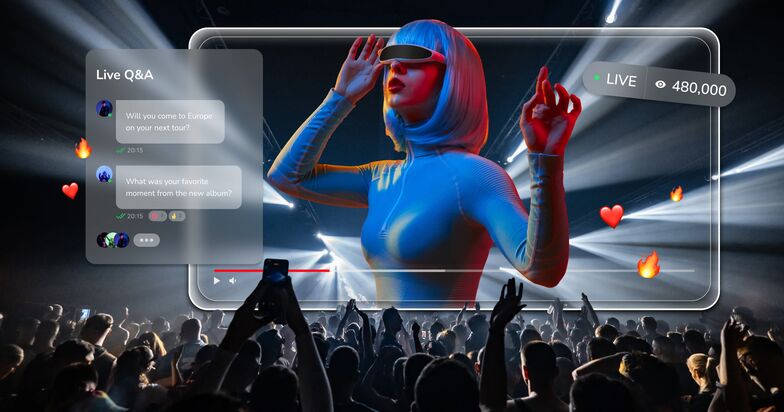
So, you've built out your media experience for the main event, whether that's for sports, music, or even a drama. Next up, you're wondering: how can you keep your fanbase engaged during those quiet moments? This is where fandom engagement platforms have a real role to play. Offering your fans a change to engage with their favorite stars on an interactive livestream comes with numerous benefits for you and your audience.
At a broad level, the fan engagement platform space is growing rapidly, expected to reach $25 billion by 2030, growing from around $8 billion in 2024. What’s driving this growth? The promise of proximity. Bringing fans closer to the talent they love, those sports stars on the roster, or celebrity singers from a concert.
Key Takeaways:
- To build a fan engagement platform, you need tight integration between the video layer and the real-time messaging.
- Cultural shifts are reshaping the relationship between fans and stars.
- Fandom is a value-add and can be offered as a premium upgrade, either based on subscriptions or as rewards in loyalty programs.
- The measurable outcome is recurring revenue and increased engagement metrics across your media platform.
What is fandom engagement, and why does it matter now?
Fandom engagement is the practice of giving fans ongoing, two-way, real-time access to the people they follow: artists, athletes, casts, and creators. It usually runs on your owned platforms that combine live chat, Q&A, reactions, polls, livestreams, and paid tiers.
For most of the 20th century, celebrity was a broadcast product. Social media added a thin layer of reply-guy access, but the platforms owned the audience, the algorithm, and the data. The artist was a tenant.
Two structural shifts have changed the economics. First, streaming flattened per-listener revenue. A casual listener generates fractions of a cent per play, so labels and leagues need a smaller group of fans who spend across many surfaces. Second, rights-holders are moving from linear and regional broadcast deals to direct-to-consumer (DTC) streaming products. Those products need interactive, sticky features to justify a subscription and keep churn down. Fandom engagement sits right where those two shifts meet. It's also why live audience engagement and real-time fan interaction has become a product category rather than a marketing tactic.
How has K-pop changed the digital relationship between fans and celebrities?
As you’re probably aware, K-pop, which originated in Korea, has become a global phenomenon. A key part of its rise is its approach to celebrity. The old model depended on distance: stars stayed out of reach, and fans consumed what came down the pipe. K-pop replaced that distance with constant, seemingly personal contact, and it treated fans as partners in an artist's success instead of an audience.
The shift happened in stages. In the late 1990s and 2000s, fandom was organized but local, built around agency-run fan clubs, official colors, and fanchants at TV music shows. In the 2010s, groups like BTS used YouTube, Twitter/X, and Naver V Live to go around domestic gatekeepers, offering unedited vlogs and behind-the-scenes streams that built global fanbases directly. A key move came with the 2020s: agencies moved those fanbases off public social networks and onto platforms they own, such as HYBE's Weverse and DearU's Bubble.
Intimacy became the product. Idols run unscripted late-night livestreams, eat on camera, and talk about their anxieties. And the cultural lesson is spreading, moving from music to sports, drama, the list goes on. Adopting K-pop's direct-to-fan model makes up for thinning streaming margins.
The premium access business model
The models that work sell explicitly gated proximity: per-artist subscriptions, tiered memberships, ticketed interactive livestreams, 1:1 or small-group video calls, paid direct messages, and priority placement in live Q&A. Fans accept a paywall when it's obvious what the gate unlocks. They resist paying for access that feels like it should be free.
The premium access model menu
| Model | How it works | Examples | Typical price signal | Best for |
| Per-artist subscription | Monthly fee for a direct chat-style feed from one artist | DearU Bubble | ~$3.50–$4.50/month per idol | Multi-artist rosters with devoted individual fandoms |
| Tiered fan club membership | Annual or monthly tiers unlock content, presales, and exclusive merch | Weverse memberships | Tier-dependent | Labels and leagues with large, varied fanbases |
| Ticketed interactive livestream | Paid access to a live show, cast Q&A, or premiere with live chat and reactions | Kiswe, Moment | Per-event ticket, often tiered | Concerts, premieres, anniversary events |
| 1:1 / 1:few virtual meet-and-greet | Timed video session with automated queueing and photo capture | Cameo Live, Looped | Premium per-session pricing | High-demand talent, limited supply |
| Lottery-based access | Purchases act as entries for scarce 1:1 moments | K-pop video call fansigns | One album = one entry | Driving volume during release windows |
| Sponsored interactive segments | Brands fund polls, predictions, or fan zones inside broadcasts | Tagboard, Dizplai activations | Sponsor fee / lead-gen | Sports broadcasts and venue screens |
Why these models outperform ads and streams
- Higher ARPU. A casual listener generates fractions of a cent per stream. A core fan pays across several surfaces: subscriptions, digital goods, album variants, tickets, and memberships.
- Revenue between cycles. Traditional entertainment revenue drops off between releases, matches, and tours. Owned platforms keep monthly recurring revenue coming in when the main media is quiet.
- Data ownership. Routing merch and membership through an owned app (Weverse Shop is the model) removes intermediary markups, gives full customer data, and makes inventory easier to forecast.
- First-party data as a second revenue line. Every poll vote, Q&A entry, and prediction is a chance to capture an opt-in email, phone number, or preference, which is more valuable as third-party cookies disappear.
TIP: Price the scarce thing, not the common thing. A question answered live, a 90-second call, or a spot in the post-show room is scarce, and that's where premium pricing belongs.
How has technology evolved to bring fans closer to celebrities?
Fan technology has moved from one-way broadcast, to public social feeds, to livestreaming apps, to owned platforms. Today there's a dedicated real-time layer that carries chat, reactions, polls, and presence alongside video at sub-second latency. Each step cuts the distance between the star's action and the fan's response. The current frontier is making that loop feel instant for millions of people at once.
Four shifts that made proximity scalable
1. Messaging split off from video. Early livestreams bundled chat into the video player, so chat inherited video's delay and scale limits. Modern stacks run a separate pub/sub messaging layer on a global edge network, so a reaction can reach the artist before the video frame showing it reaches the fan.
2. Second screens became the norm. More than 80% of sports fans use a second screen while watching live broadcasts. Product teams moved from long-form interactions to "snackable" micro-engagements: one-tap reactions, quick polls, and single-click predictions that don't pull fans' eyes off the game for long.
3. The web replaced the app install. Drop-off on dedicated app installs pushed demand toward Progressive Web Apps and browser experiences opened by a QR code. "No app required" is now a procurement requirement, not a nice-to-have.
Why build the infrastructure for fandom interactivity
PubNub is infrastructure, not a fan app. It doesn't compete with Weverse, Bubble, or Cameo for fans' attention. We provide the real-time layer so a company builds its own Weverse or Bubble, keeping control of the fan experience and data.
In that build, the league owns the fan-facing product: the app, the design, membership tiers, video, commerce, and the CRM. PubNub runs the real-time parts underneath, which are the hardest to scale:
| What the fan experiences | What PubNub provides underneath |
| A player's message landing in every member's feed as if it were personal | One-to-many broadcast fan-out to millions of subscribers |
| Live match-day chat and watch parties | Sharded chat channels with message history |
| "48,212 fans here now" | Presence and occupancy |
| Emoji bursts and live polls during a player Q&A | High-frequency signals and real-time vote aggregation |
| A VIP room only top-tier members can enter | Channel-level access control tied to the league's membership tiers |
| Questions moderated before they reach the player | Pre-delivery message filtering and moderator routing |
If you want to own the fan relationship, you build the experience and put infrastructure like PubNub underneath it.
What features does a fandom engagement platform need?
A fandom engagement platform needs three tiers of capability. The foundations are real-time chat, presence, identity, and moderation. The engagement mechanics are Q&A queues, polls, reactions, and VIP tiers. The differentiators are moments that make fans feel individually seen, such as on-stage pull-ups, personalized broadcast messages, and synchronized crowd effects. Most failed launches skip foundations and jump to differentiators.
Tier 1: Foundations
- Real-time fan chat: Delivery fast enough that fans are reacting to the same moment as the star. Chat that lags behind the stream feels like shouting into a void. See in-app chat for fan communities.
- Presence and occupancy: Live counts ("48,212 fans here now") and join/leave signals that make a room feel full, and show talent that someone is actually there. See presence signals for live rooms.
- Identity and entitlements: Persistent fan IDs, membership tiers, and per-channel permissions so VIP rooms stay VIP.
- Moderation: Profanity and harassment filtering before messages reach talent, plus human moderator tools, rate limits, and mute/ban controls.
- Message history: Late joiners can catch up, and moderators can audit what happened.
Tier 2: Engagement mechanics
- Moderated Q&A queue: Fans submit and upvote questions, moderators approve, and talent answers live.
- Live polls and predictions: One-tap participation, with results pushed back to the stage or broadcast as they come in.
- Emoji reactions at scale: Lightweight, high-frequency signals rendered as bursts and aggregated rather than stored individually.
- Tiered rooms: Free public chat, member-only rooms, and a small VIP backstage channel, each with different permissions.
Tier 3: Differentiators
- On-stage pull-up: A fan's question or video feed gets promoted to the main stream in real time.
- Simulated 1:1 messaging: Bubble-style broadcast messages rendered as personal chat threads.
- Shoutout and "seen" moments: Talent reacts to a specific fan by name, and the platform makes that moment shareable.
- First-party data capture: Opt-in fields inside polls and Q&A entries, synced to the CRM.
- Live translation: Global fandoms need chat and Q&A to work across languages as it happens.
How do you build a fan engagement platform, step by step?
Build a fan engagement platform by working backward from a single proximity moment, such as a live Q&A with 500,000 fans. Design channels around audience segments, enforce identity and tiers at the channel level, moderate before messages reach talent, and plan for traffic bursts that arrive in seconds.
Step 1: Define the proximity moment you're selling. Write down, in one sentence, the moment a fan will remember. For example: "During the anniversary livestream, the artist answers my question live and says my name." Everything else follows from this. It tells you whether you need WebRTC video (a 1:1 call), a real-time data channel next to LL-HLS (a large Q&A), or a synced second-screen overlay (a match broadcast).
Step 2: Design channels around audience segments. Channel design is where most fan platforms succeed or fail at scale. A common pattern for a single event:
| Channel | Purpose | Who can publish | Who can read |
| event.{id}.stage | Stage state: now-playing, poll open/close, Q&A question on screen | Producers only | Everyone |
| event.{id}.chat.{shard} | Public fan chat, sharded to keep rooms readable | Authenticated fans | Fans in that shard |
| event.{id}.qa | Question submissions and upvotes | Authenticated fans | Moderators |
| event.{id}.reactions | High-frequency emoji bursts | Everyone | Everyone |
| event.{id}.vip | Backstage room for top-tier members | VIP fans + talent | VIP fans + talent |
Sharding public chat matters. A single room with 500,000 people typing is unreadable. Splitting into rooms of a few thousand keeps conversation human, while reactions and stage events still fan out to everyone. See channel design for audience segments.
Step 3: Moderate before messages reach talent. Run automated filters or AI moderation on messages before they're delivered, not after. Send the Q&A channel to a moderator console, never straight to the artist's screen. Protecting the star keeps the star willing to show up again.
Step 4: Wire it up. Each fan client subscribes to three things: its chat shard (with presence turned on for live fan counts), the stage channel, and the reactions channel. Chat messages and Q&A submissions are published as normal messages. Emoji reactions go out as lightweight signals built for high frequency. Stage events such as "poll open" or "question on screen" come only from the producer console, so every fan sees the same moment at the same time.
Step 5: Measure closeness, not just clicks. Track the metrics that show fans felt close: questions answered, percentage of attendees who took part in at least one poll, reactions per minute during talent-on-screen segments, VIP upgrade conversion during the event, and return rate for the next event.
Should you build or buy a fan engagement platform?
Most teams should build the fan experience and buy the real-time infrastructure under it. Turnkey platforms are fastest but give you the least control over brand and data. Overlay SDKs suit broadcast-first teams. Fully DIY WebSocket stacks give total control but carry the burden of scaling to global bursts. Managed real-time infrastructure is the middle path for teams that want to own the product.
Option 1: Build it yourself on raw WebSockets
You run your own socket servers, fan-out, presence, history, and global routing. You get total control and no vendor dependency. You also take on the hardest part of fan engagement, which is surviving the 30 seconds after the artist goes live, plus multi-region failover, connection storms, and 24/7 on-call. This makes sense if real-time infrastructure is your core business. For more on the trade-offs, see why teams choose managed real-time infrastructure over DIY WebSockets.
Option 2: Managed real-time infrastructure + your own product
You design the fan experience, brand, tiers, and data flows, and a real-time platform like PubNub handles delivery, presence, and scale. This is the pattern behind most owned fan apps, and it's the right choice for a league or studio that wants a fandom hub under its own brand.
Option 3: Enterprise overlay and second-screen SDKs
LiveLike, StreamLayer, Dizplai, and Tagboard provide ready-made widgets (polls, trivia, predictions, social walls) that plug into existing apps and broadcasts. They're fast to deploy, but the experience looks more like theirs than yours.
How does PubNub support fan engagement platforms?
PubNub provides the real-time interaction layer for fan platforms: chat, presence, reactions, polls, Q&A, and stage-state sync delivered over a global edge network. Teams build their own branded fan experience on top without running socket infrastructure. Leagues, studios, and entertainment apps use it to run live fan moments that stay responsive when a star goes live. For example, take a look at the fanzone that DAZN built with PubNub.
If you're scoping a fan chat, live Q&A, or virtual meet-and-greet experience, start with PubNub platform fundamentals, then review pricing for scaling fan experiences as you plan for peak concurrency.
Conclusion: How should you build a fandom engagement platform in 2026?
When it comes to building a fandom engagement platform, remember you're selling proximity and not content. As we saw with the emergence of K-pop, the ongoing relationship with the talent is the product.
Think about the moments that fans will pay to remember and focus on these. Owning the channel comes with serious benefits: you get to reinforce your branding, and control the experience, the data, and the commerce.
Split the interactive layer from the video platform, so that you can better manage latency, deal with chat reactions, polls, and moderation, all on a platform that's actually built for bursts.
Ready to get started? Check out PubNub solutions for sports, media, and entertainment, or talk to a solutions specialist.
