
The slot machine hasn't changed in 100 years. That's the opportunity: GaudHammer's Anthony Gaud on real money video games and the future of iGaming
The average slot machine hasn't meaningfully changed in roughly 100 years. The average online casino experience hasn't changed much since it moved to the internet. But the average person who might gamble? They've changed enormously, and there's now a 30-year gap between what the industry offers and what a generation of potential players actually wants.
That gap is what Anthony Gaud, co-CEO of GaudHammer Gaming Group, has spent years trying to close. His background is unusually wide: toy design at Hasbro, pioneering CG animation at Mainframe Studios in the late 90s (Reboot, Transformers, Beast Wars), building cable on-demand networks with Comcast, and eventually serving as Creative Director at Disney Interactive on Kingdom Hearts, Marvel, and Star Wars. Now he's in the business of combining regulated gambling with video game mechanics — and the opportunity he sees is hard to argue with.
The 30-year gap
The average gamer is somewhere around 35 or 36 years old, Anthony points out. Not a teenager, and not a retiree. The average online gambler skews closer to 45 or 50. "You have basically almost 30 years there — 29 years that you're not finding a product specifically tailored for these customers," he says. "And these customers have been shown to engage."
They've engaged with loot crates, battle passes, daily login rewards, and progression systems. They understand chance-based mechanics and micro-transactions intuitively. What they don't have is a betting product that feels like it was built for them.
Crash games as proof of concept
The clearest evidence that something new is working comes from a format most people outside iGaming haven't heard of: crash games. One of the most popular crash games is Aviator, made by a company called Spribe, which centers on an airplane that takes off while a multiplier climbs. Players bet on when to "jump out" before the plane explodes. Simple premise, staggering results.
"They're making $3 billion-plus GGR on this product," Anthony says. "One game. It's not one game with different variations. It's just the one game." Depending on which numbers you use, crash games now account for somewhere between 7% and 20% of the European and South American markets, and they've existed for only a couple of years. "Even if it is at the low end, seven, or at the high end twenty, that's huge. That shows you that people are looking for a new way to gamble."
For Anthony, crash games aren't the destination, they're the entry point. Take that format and layer on what mobile gaming has perfected over a decade: regular content updates, short- and long-term progression, community features, cosmetic customization. "If I win $100, my plane turns gold or whatever." That's how you go from a novelty to a platform.
Use the content as the attract
One of Anthony's sharpest critiques of the current iGaming industry is how it thinks about retention. "Right now, the only way that iGaming does it is usually by just saying, here's $300 to match your bet or some sort of money outlay. And we need to move past that, because we can use the content as the attract."
The contrast with how video games retain players is stark. New characters, environments, daily challenges, seasonal events, community competitions: none of it requires writing a check to the customer. It requires building something people want to come back to. "Once they're into that metagame, it's a lot easier to keep people, because other companies won't be able to match what you're doing."
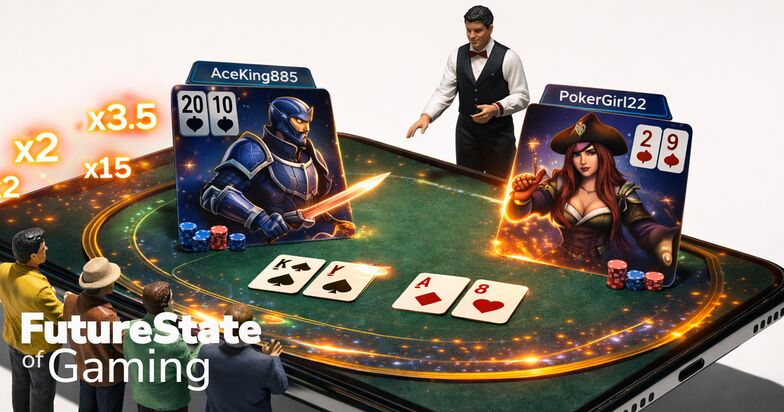
He offers a vivid illustration: imagine a card combat game where a winning hand lets you take a swipe at another player's character, and whoever is alive longest wins the pot. "That's a game I'm going to play. That's a game a lot of people are going to play. And that's a game a lot of people who wouldn't play blackjack are going to play."
The technical mountain underneath
What makes this space defensible is the engineering complexity beneath the surface. A crash game looks simple to play. The infrastructure that makes it legal and auditable is not.
Anthony breaks it down: random number generators that can be independently tested and certified, code architectures with no backdoors, anti-money-laundering pattern detection across multiplayer sessions, millisecond-level action logging across thousands of simultaneous players, and record-keeping that has to hold up to regulatory scrutiny years after the fact. "If someone from nine and a half years ago says, hey, I think I was cheated out of this match, you have to be able to recall the match." His team includes veterans from Xbox, Microsoft, Activision, and EA. "This is by far the hardest thing that they've done."
That difficulty is also a moat. "Once we've created the system, that's where we feel the benefit is — we're creating a system that we can build bigger things on down the road."
The next EA is forming
Anthony's prediction is direct: he expects "the next Electronic Arts to be formed in the next two to three years in the iGaming space" as a company built more like a game publisher than a casino operator. It will communicate with its fanbase, build IP people feel loyalty toward, and differentiate on experience rather than just odds.
"You'll see brands become very important. Casinos will want to find products that are their Mario's or their Sonics or their God of War. And then people will not just be at the casino, they will seek them out." One casino might specialize in racing games. Another in action titles. Another in puzzle mechanics. Today, he notes, "all the casinos, other than the names, are all the same."
He draws the comparison explicitly to where video-on-demand started: a show you could watch on Comcast, and where it went when Netflix and YouTube arrived. "I think the video game industry and real money video games are set to do the same thing to gambling." The companies that move first will define the category. Everyone else will rush to be second.
This conversation was part of the Future State Of Gaming series. Listen to the full episode. You can connect with Anthony on LinkedIn.
