
The moment is the product: how LiveLike is reinventing fan engagement
Picture how you used to watch a big game. You sat on the couch, the TV was on, maybe a friend or two was in the room, and the broadcast told you everything you needed to know. Simple. Linear. Complete.
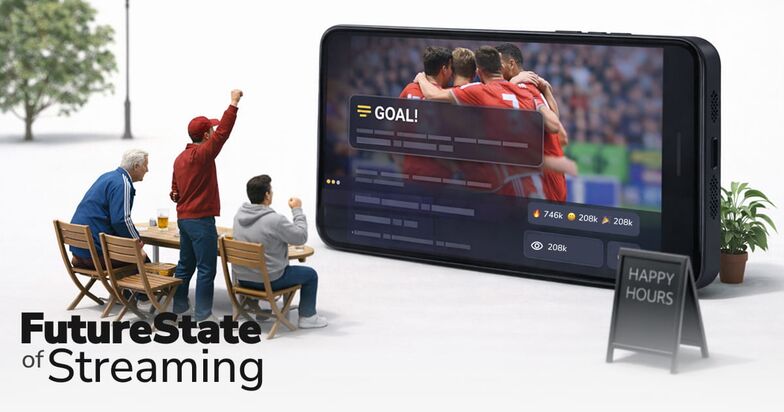
Now picture a teenager watching the same game today. Phone in hand, fantasy league open in one tab, a group chat with six friends running in another, live stats loading in a third. The TV is on. But it's almost set dressing.
That shift is not a distraction. It's the future of sports. And the organizations that understand it are already building something different.
I had the chance to talk with Alex Hay, head of business development at LiveLike, for a recent episode of the Future State of Streaming. LiveLike powers fan engagement technology for some of the biggest names in sports and media: Major League Baseball's official loyalty program, the social features inside Yahoo Fantasy, and the community layer behind Bleacher Report.
The second screen story was always told backwards
For years, the industry called mobile the "second screen." The thinking was: television is primary, everything else is supplementary.
Alex flips this framing. "For Gen Z, the mobile phone is actually not the second screen. It's the first screen. The linear becomes the second screen."
It sounds like a small semantic shift. The implications are enormous.
If mobile is the primary viewing experience, then the broadcast is the backdrop. Your fans' actual experience is happening in apps, group chats, and social feeds. And if your organization isn't present in those spaces, you're invisible during the very moments you work hardest to create.
The data backs this up. Over 80% of people watching sports today have a second screen in hand. For younger fans, that number approaches everyone.
The moment is the product
What makes live sports uniquely powerful is not the final score. It's the moment when everything changes: the last-minute goal, the penalty call, the crash on the formation lap. These moments are at the emotional core of fandom.
Alex describes a shift in how organizations need to think about engagement. Not just "we have fans watching," but "what happens when the moment hits?"
Take LiveLike's work with Yahoo Fantasy. When Patrick Mahomes scores a touchdown, every fantasy owner who has him on their roster gets an instant notification. That notification drops them directly into a dynamic chat with every other Mahomes owner in real time. Suddenly, a group of fans spread across the country is united around a shared experience they all care about.
That's the connective tissue. Not the broadcast. Not the app itself. The moment, amplified and made social.
"Fans aren't fans of Formula One," Alex points out. "They're fans of Ferrari, or Oscar, or Lewis. Being able to meet fans where they are and drive engagement around who and what they actually care about is what drives fandom forward."
Owning the conversation matters more than ever
There's a version of fan engagement that leans entirely on social platforms: post the highlight, watch the replies come in, let the algorithm distribute. It's convenient. But it comes with a serious strategic problem. When fans engage on someone else's platform, you don't own that relationship. You don't know who those people are, what they care about, or how to reach them again. You're building on rented land.
The shift Alex sees in forward-thinking sports and media organizations is a deliberate move to bring fans into owned platforms. Real-time chat inside team and league apps. Interactive widgets during match centers. Live polls and prediction games layered on top of the broadcast experience from a league or club.
The goal is to build the place where the conversation happens, and to be the host.
"Media companies used to just broadcast content to social media," Alex said. "Now we're seeing them lean into innovative ways to bring fans into their own ecosystem on a more regular basis, so they become part of the conversation."
If you're still treating your app as a schedule and a score ticker, you're missing the moment where real fandom lives.
First-party data is the real prize
There's a practical reason beyond community-building for why owning the fan experience matters: data.
The third-party cookie era is effectively over. The old model of following audiences around the internet to understand behavior and serve targeted advertising is getting harder every year. What replaces it? First-party relationships, built directly with fans, on platforms you control.
When fans interact with chat features, engagement widgets, interactive polls, and loyalty programs inside your owned app, every action is a signal. What moments spike engagement? Which players or storylines generate the most discussion? What drives a fan from passive viewer to active participant?
That behavioral data is extraordinarily valuable. It informs content strategy, personalizes experiences, and creates advertising and sponsorship products that can actually prove their value.
Alex puts it directly: "The more fans are interacting with different elements on the page, the more data we're gathering that we can use for marketing purposes, monetization, and ultimately optimizing the user experience."
Understanding what your fans actually care about, not what you assume they care about, is a competitive advantage. And you build it one moment at a time.
Community becomes a product in its own right. AMAs, digital player appearances, fan-driven experiences inside owned platforms. The access economy around sports talent is just beginning.
"The thirst for engagement is not going away," Alex says. "It's going to become more immersed into the way that we consume sports and media and entertainment more broadly."
AI orchestrates engagement
Every conversation about technology in sports eventually reaches AI. The question Alex gets asked most is where it actually creates value, beyond chatbot demos and AI-generated highlight reels.
His answer is more interesting than the typical response.
"The real opportunity," he said, "is once you can start to translate strategy into automated orchestration."
AI-driven orchestration means fan engagement strategies can execute automatically, triggered by real events in the game. LiveLike’s Genie AI is a great example of this. A red card triggers a poll. A record-breaking moment triggers a community notification. A fan who hasn't opened the app in three weeks gets a re-engagement push timed to the next fixture, personalized based on their past behavior.
"Being able to automate all of that allows people to spend a lot more time actually enhancing the strategies that sit behind this," Alex says. "And really dialing down how we do this on a one-to-one level."
The practical implication: engagement at scale becomes possible without linear increases in editorial headcount. And personalization at the individual fan level, not just the segment level, becomes achievable.
The infrastructure question
Here's the part that often gets overlooked in these conversations.
The moments that matter in sports are, by definition, simultaneous. When a goal is scored, millions of fans need to receive that trigger at the same time. When a chat group forms around a moment, it needs to handle a spike in concurrent messages without lag. When a loyalty reward drops, it needs to reach the right fan at the right second, not two minutes later.
This is where real-time infrastructure becomes the invisible foundation of fan engagement. The platforms that get it right have invested in the layer that sits between the live event and the fan's screen, making sure every moment arrives in time to matter. And the platforms that haven't? Their fans feel it, even if they can't name it.
Getting that infrastructure right is what separates a fan engagement strategy that looks good in a deck from one that actually works on championship night.
Start with the moment
If there's one takeaway from talking with Alex, it's this: the teams and leagues winning at fan engagement aren't thinking about features. They're thinking about moments.
What happens when the play everyone will be talking about tomorrow actually occurs? Is there a place for your fans to gather around it? Is that place yours? Are you capturing what that engagement tells you about your audience?
The organizations that understand that and build for it are the ones that will own the fan relationship for the next decade.
This article is based on a conversation with Alex Hay, head of business development at LiveLike, on the Future State of Streaming podcast. LiveLike provides fan engagement, community, and loyalty technology for sports leagues, media companies, and entertainment organizations worldwide.
