The lean-forward TV: How second screening, voice AI, and interactive apps are rewriting what happens in the living room

The TV is becoming a home agent. The remote may not survive it.
There's a moment Matt Duhig describes that makes the whole argument land. His team member's five-year-old daughter was handed a MacBook for the first time. Instead of reaching for the keyboard or the trackpad, she looked around the device, searching for where to speak to it. That's natural for her, as talking to tech is the most natural interface she'd ever known.
That story is where connected TV (CTV) is heading. Duhig, CEO of FX Digital, thinks the shift is closer than most people in the industry are willing to say out loud.
FX Digital builds and QA-tests CTV applications for some of the biggest names in streaming: BritBox, ATP Media, and the BBC. Across their London and Barcelona offices, they maintain somewhere between three and four hundred physical devices: every smart TV, streaming stick, set-top box, and gaming console that matters. If anyone has a ground-level view of what the connected TV can and can't do right now, it's them.
Hardware isn't where these guys compete anymore
The thing that struck Duhig recently from the viewing experience on a connected TV was an Uber Eats ad on the hero banner of his LG TV home screen. It clicked through to a broken webpage at the time, but the intent was unmistakable.
"I really don't think we're that far from that click-through going through to either a landing page for Uber Eats or, better yet, a TV application that allows potentially a group of people in the same room to all order food together."
That's not a streaming story. That's a platform story. And it maps onto something Duhig sees in how the major TV manufacturers are behaving right now: Samsung, LG, Google, and Hisense are all investing heavily in their platform software, not just their panels. Innovation follows money, and advertising money is migrating back to the living room. Not to the broadcast linear TV of twenty years ago, but to the data-rich, one-to-one delivery that a connected TV can offer. Where the ad spend goes, the product investment follows.
The comparison Duhig draws is to the smartphone. Not a prediction that the TV replaces mobile (he's clear it won't), but an observation that the trajectory has a familiar shape. The TV is transitioning from a single-purpose device into what he calls "a more general purpose device in the home." Netflix party-style games are already ranking third in App Store downloads. Airbnb and Uber could well be next.
Give people a reason to second screen
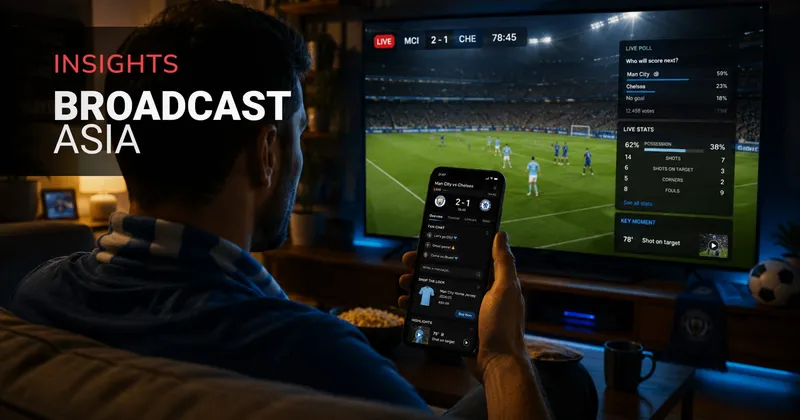
Something is already happening in the living room that platforms mostly aren't designing for. Duhig's team ran UK research into Gen Z and millennial viewing habits and confirmed what anyone who's watched a football match with a teenager already knows: the phone is always there. Sometimes it's social: texting about what just happened on screen. Sometimes it's doom-scrolling something completely unrelated. The two devices are running in parallel, loosely coupled, mostly by accident.
YouTube is the exception. Their "lean forward" experience lets you connect your phone to the TV app, comment on videos, and browse the platform without ever picking up the remote. Duhig uses it personally. He'll open YouTube on his phone, throw a music video to the TV, and then control everything from the phone for the rest of the session, ignoring the remote entirely.
"YouTube have quite nicely married the two devices together to provide a much more user-friendly experience in navigating their application."
But his more interesting point is about incentives. Right now, second screening happens despite platforms, not because of them. The question is whether you can engineer reasons for it. His example: connect your phone to Netflix while an ad is playing and you get to skip the ad. Right below the skip button sits a "learn more" option. A mid-roll interruption becomes an opt-in engagement moment, with higher-value for advertisers and useful for the viewer.
"When we start to think about second screen experiences, there's so much that can happen between a smart TV and a phone, such as providing a useful level of depth to advertising."
It's a small idea with a big implication: the phone isn't the TV's competitor in the living room. It's its best interaction layer. Identity, payments, personalization, and social participation all work more naturally on a touchscreen than navigated through a d-pad remote.
The conversational interface is almost here
Voice is what ties the rest of this together. Duhig is careful not to overstate: the voice APIs on most CTV platforms aren't yet exposed to third-party developers. YouTube and Netflix have each recently launched in-app voice features (YouTube's "ask" feature lets you speak directly to a video while it's playing; Netflix's allows natural-language discovery), but they've had to work around the operating system to get there. Most apps, if you press the microphone button, still hand control back to the device OS.
That's a temporary constraint. When it changes, Duhig thinks the results compound quickly.
"Once the devices open up and expose those voice APIs, the amount of experiences that could be built for television just explodes."
They're watching what Apple and Google built with app ecosystems and taking notes. If someone orders a takeaway through a voice-enabled app on their LG TV, LG takes a cut. The incentive to open those APIs is real.
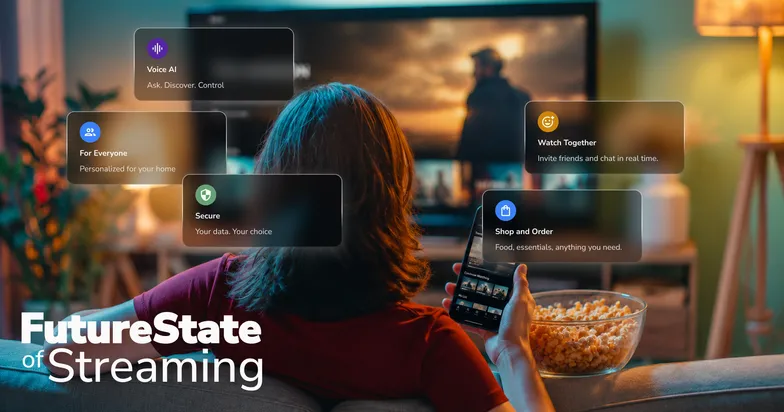
The result, over the next five years, is a TV that functions less like a passive screen and more like what Duhig calls "a home agent": something you speak to, that organizes things, buys things, finds content, and understands the collaborative, shared nature of the room it's in. Not a phone on a wall. Something distinctly its own.
"I think we are set to see a bit of an explosion of the types of apps that are available to us on these devices."
Netflix defined the last decade of streaming. Duhig's bet for the next one is YouTube. Not because of its content library, but because its product team has consistently pushed what a TV app can do.
This conversation was part of the Future State Of Streaming series. Listen to the full episode. You can connect with Matt Duhig on LinkedIn.