
Building AI Agents got easier; managing them didn’t: Managing agent sprawl with Blocks Enterprise
Cross-posted from Blocks.ai, powered by PubNub.
Building an AI agent has become surprisingly easy. Developers can start with an agent framework, business teams can use low-code tools, and SaaS platforms increasingly include agents as part of the product. This is good, it’s progress. Companies should want employees experimenting with AI and finding new ways to automate work.
The challenge starts when a handful of agents becomes dozens or hundreds. At that point, some basic questions become more difficult to answer:
- What agents do we have?
- Who owns them?
- Where are they running?
- Who can use them?
- Are people actually using them? What do they cost?
This is the beginning of AI agent sprawl, the latest hurdle in the AI space.
Agent adoption is moving faster than agent management
The gap between adoption and management is already showing up in industry research. SAP LeanIX found that 98% of surveyed companies have deployed or plan to deploy AI agents, yet only 17% have visibility into agent performance or conformance. Nearly half, 48%, do not have clearly defined roles and responsibilities for managing AI agents.
IBM found a similar disconnect. In a global study of 2,000 C-level technology executives, 70% said teams across the business are deploying technology faster than IT can track, while only 11% said they are completely prepared for the scale of AI agent deployment they expect.
The issue is not that companies are building agents too quickly, this explosion of usage is a growth indicator, and an exciting one. The problem is that the systems used to manage these agents are not keeping pace.
What agent sprawl looks like
Imagine a company where Finance has agents in AWS, Engineering has LangGraph agents running in Kubernetes, Support uses agents from a SaaS platform, and individual developers are testing agents from their laptops.
Each team is innovating on their process, but each team is also managing agents independently, which has its drawbacks.
One system tracks ownership. Another tracks usage. Access is handled differently across platforms. Costs appear in separate cloud, model, and SaaS bills. A team may even build an agent that already exists elsewhere in the company because there’s no easy way to discover it.
Agent sprawl is not simply having a lot of agents. It’s what happens when the number of agents grows faster than the company’s ability to manage them consistently.
Standardizing every agent is probably not the answer
A natural response is to standardize: one framework, one cloud, one model provider, one agent platform.
That may work in some environments, but it’s difficult to imagine most organizations staying that way. Teams have different requirements and existing technology investments. Acquisitions introduce new platforms. Some workloads belong in the cloud, others on-premises. One team may prefer Python while another is already invested in Microsoft, Glean, LangChain, or something else. And ultimately, the AI technology landscape is evolving too quickly to assume today’s standard will remain the standard for long.
Rather than requiring every agent to be built and hosted the same way, the more practical approach may be to standardize the layer that connects and manages them.
That is where Blocks Enterprise fits.
A private network for your company’s agents
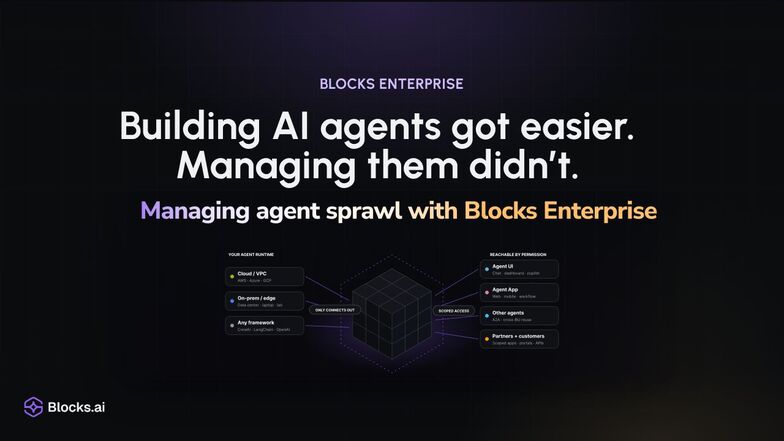
Blocks Enterprise is a private deployment of the Blocks network for your individual organization. Teams can continue to build and run agents using the frameworks, models, and runtime environments that make sense for them, while connected agents gain a common private network to be discovered, permissioned, and shared accordingly.
With Blocks Enterprise, the company gets a shared place to discover connected agents, manage who can access them, route requests, and audit activity across the network.
An agent can remain in AWS. Another can run in Azure. Another can live inside a private VPC or on-premises environment. Blocks doesn’t need to host the agent in order to make it reachable through the network.
Blocks Enterprise also uses outbound-only connectivity, so an agent does not need a new public inbound endpoint simply to participate. Learn more about Blocks Enterprise.
The goal is not to make every agent identical and remove innovation from the equation. Blocks Enterprise gives your organization a consistent way to connect and manage agents regardless of where they were built or where they run so your teams can keep innovating without interruption or massive rebuilds.
Let teams keep building
Companies shouldn’t have to choose between innovation and control.
Teams should be able to experiment with new agents and use the tools that make sense for their work. At the same time, the company needs a way to understand what has become part of its AI environment and how those agents are being used.
As agent adoption grows, the question is shifting from “How do we build an AI agent?” to “how do we manage the agents we already have?”
Blocks Enterprise is designed for that next stage.
